
Marine construction
Bulkhead Construction on Lake Livingston
Wood bulkheads for lakefront, canal and pond shorelines, built by a local crew with the equipment to set them.
Holding the bank in place
Waves, boat wakes and runoff wear away an unprotected shoreline. Over time the bank undercuts, the yard creeps toward the water, and trees and structures near the edge can be put at risk. A bulkhead is a retaining wall at the water's edge that helps hold the soil behind it.
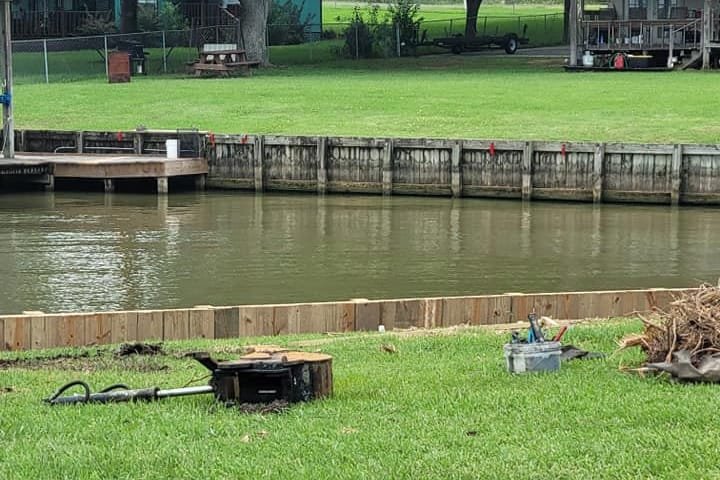
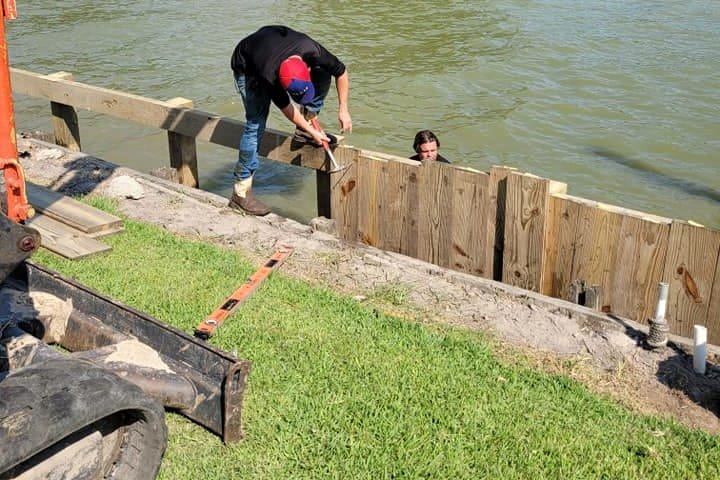
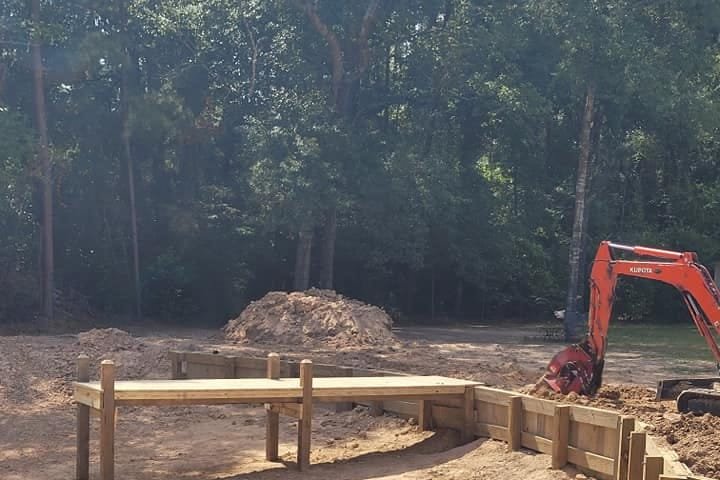
Onalaska Builders builds bulkheads with our own crews. Recent work includes a new wood bulkhead along a canal lot, set with the help of a mini excavator, and a timber bulkhead at a private pond with a dock walkway built over it.
Bulkhead work includes:
- New wood bulkheads on lakefront, canal and pond property
- The excavation and backfill around the wall
- Planning a bulkhead together with a new dock, pier or boat ramp
Your shoreline
Signs your shoreline needs attention
- The bank is undercut or has a steep, crumbling edge
- Soil, sand or roots are showing and washing into the water
- The yard is losing ground toward the water
- An existing bulkhead is leaning, bowing or has gaps, with soil escaping behind it
- Holes or sinking spots in the ground behind an old wall
Erosion rarely stops on its own. Catching it early usually means less soil to replace and more options for fixing it.
The work
How a bulkhead project comes together
- Look at the shoreline. Length, height of the bank, water depth, access and what is washing out.
- Plan the wall and what goes with it. If a dock or pier or a boat ramp is part of the plan, it makes sense to lay them out together.
- Prepare the bank. Excavation along the line of the wall. We handle excavation and grading ourselves.
- Build the wall. Setting the bulkhead along the shoreline.
- Backfill and finish. Filling behind the wall and shaping the ground above it.
If water is running across the yard toward the bank, site drainage may be worth planning at the same time.
Materials
Common bulkhead materials
Bulkheads on inland lakes are built from a few common materials, each with trade-offs:
- Wood. Treated timber is a traditional choice with a natural look that suits wooded lake lots. It is what our recent canal and pond bulkheads are built from.
- Vinyl or composite sheet piling. Interlocking panels that will not rot, often chosen for long runs of shoreline.
- Steel sheet piling. Strong, and used where wave action or wall height calls for it.
- Concrete. Poured or precast walls, and sometimes a concrete cap on top of another material.
The best fit depends on how exposed the shoreline is, how tall the wall needs to be, the soil and the look you want.
Upkeep
Looking after a bulkhead
- Watch the ground behind it. Sinkholes or low spots can mean soil is escaping through or under the wall.
- Keep water moving away. Rain that collects behind a wall adds pressure. Downspouts and yard drainage should not dump water right behind it.
- Check after storms and high water. Look for leaning sections, gaps between boards and debris against the wall.
- Mind what grows along it. Large roots close to the wall can push on it over time.
Budgeting
What affects the cost of a bulkhead?
- Length and height of the wall.
- Materials used for the wall.
- Site conditions, including water depth, soil and how much fill is needed behind the wall.
- Access for equipment and materials.
- Removing an old wall, if there is one.
- Related work, such as a dock, a ramp, steps or grading above the wall.
Send the form with the town or ZIP code, the rough length of shoreline and a few photos.
Lake Livingston
Bulkheads around Lake Livingston
Lake Livingston's shoreline includes open-water lots that take the full force of wind and waves, quieter coves, and canal neighborhoods. Work on the lake's shoreline falls under the Trinity River Authority, which runs a permit process for property owners, and some subdivisions have their own rules. Check what applies to your lot before work starts.
We build bulkheads around the lake, on canal lots and at private ponds within about 35 miles of Onalaska. See our full service area.
More marine construction services
Related services
Questions
Bulkheads questions
What does a bulkhead do?
A bulkhead is a retaining wall at the water's edge. It helps hold the soil behind it so waves, boat wakes and runoff do not keep wearing the bank away.
Do you build bulkheads on canal lots and ponds?
Yes. Recent work includes a wood bulkhead along a canal lot and a timber bulkhead at a private pond.
What are bulkheads made of?
Common materials are treated wood, vinyl or composite sheet piling, steel sheet piling and concrete. The right choice depends on how exposed the shoreline is, the wall height, the soil and the look you want. Our recent bulkheads are wood.
Can you build a dock with the bulkhead?
Yes. At a private pond we built a dock walkway over the new bulkhead. Planning both together lets them be laid out to work with each other.
Do I need a permit for a bulkhead on Lake Livingston?
Work on Lake Livingston's shoreline falls under the Trinity River Authority, which runs a permit process for property owners. Some subdivisions have their own rules too. Check what applies to your lot before work starts.
Get started
Is your bank washing away?
Tell us about your shoreline and where the property is. Send the form or give us a call.